
Hitching Her Stories to the Stars
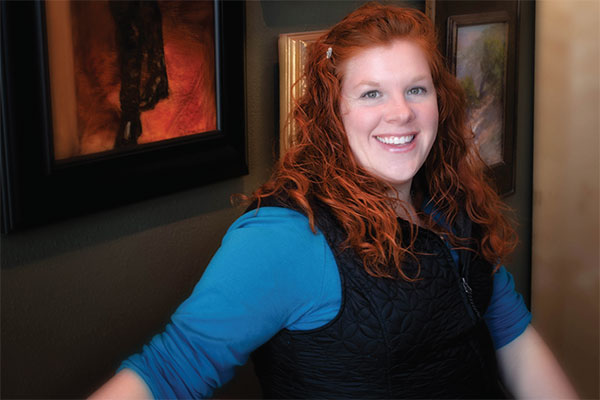
Josi Russell in her writing studio flanked by her husband's paintings.
You will want to cut Josi Russell a little slack when she resumes her duties in the fall as associate professor of English on the Utah State University Eastern Blanding campus. Her year-long sabbatical took her beyond the planet Minea and into the midst of a highly advanced, hostile alien race — publishers and critics.
Just kidding, Future House Publishing. Haha. Wink. Wink. You too, brusque, insensitive internet critics. Minea is actually a planet of Russell’s making. And any reservations about getting her stellar stories published was also of her making. Fact is, Russell stared down her monster and triumphed. Future House is more like home sweet home as far as she is concerned with the publishing of her first two science fiction novels the past six months. One has already been made into an audiobook and the second soon will be.
That monster of hers, incidentally, was a fear that many budding authors share in common, the dread of rejection. “I was so sure of rejection after I sent the manuscript that I didn’t check my email,” she says. “The acceptance letter from my publisher had been in my inbox nine
days when I finally saw it.”
Creating something for all the world to see, as with any artistic endeavor, can be a scary thing. It is a highly personal act, and so it is hard not to take what others say and think about it personally. Same goes for taking a creative writing course. Just the thought of that red ink can send shivers down one’s spine.
If any student who plans to take Russell’s class this fall is nursing such apprehensions, he or she can stop now. The color of ink in the pen she wields is not fire-engine red, it’s Valentine’s red. She is passionate about what she does and loves her students. She has also gained some fresh insights along the way of getting published that make for a choice step-by-step primer for future authors.
Step one, she will tell you, is observation. Be fanatical about it.
“Writers should be more observant than others,” she says. “That’s true of artists in general, I think. We have to see, hear and feel things in order to write well about them.”
She never goes anywhere without keeping a notebook nearby, says her husband, Richard Lance Russell. He smiles as he says that because he had to admit, he never goes anywhere without his sketchpad. He is a full-time oil painter. These are essential tools of their trades.
Russell says she has filled dozens of notebooks over the years. Finding the time to sort through those little bursts of inspiration and make sense of all her random thoughts weighed heavily on her. The two hours a day she set aside for writing was helpful, but she knew she would need more time than that to get her creations from manuscripts to published works. If anyone could use a little more time, she surely could. Civilizations on distant planets depended on her almost as much as she relied on the rejuvenating, calendar-clearing promise of a sabbatical.
It’s been invaluable to me,” she says. “It has given me the time to edit, attend signings and conventions, work on new manuscripts and fully engage with the publishing process.” It has also moved the entire procedure along much more quickly than she originally anticipated. Last fall she set a goal to get her first book published by April. It is a literary fiction called The Wildflower Café. At the time, she was also working on the final stages of a science fiction novel called Caretaker that she decided to send off to her publisher to see if there might be some interest — a little dipping her toe in the water, as she described it.
Before she knew it, she was up to her neck and happily launching her first space adventure, Caretaker. It was published in November and quickly followed by its sequel, Guardians (Caretaker Chronicles Book 2), published in February — both Future House Publishing best sellers on Amazon. In addition, Caretaker has been named a finalist in both the Speculative Fiction and the Best Novel by a New Author categories in the 8th annual Whitney Awards celebrating excellent fiction by Mormon authors. All the while, her third sci-fi, Shadows of Empyriad, is in manuscript form.
This early success comes as no surprise to her family and friends, her husband says. It’s been a passion of hers since the second grade, a flame burning deep inside as brilliant as her vermillion hair. He talks about friends and family posting on her Facebook page saying how they remember listening to her stories as children. They even put on a play once.
“As soon as I learned to write, I was making stories,” she says. “I loved stories, as many children do, but I loved creating them. I would make up stories that I would tell my cousins and riends, and they were even serialized!” It was not until her study abroad in England, as an animal-science major at Brigham Young University, that the thought of being able to do this for a living dawned on her.
“I went to London on a whim to study British literature and I just fell in love with English all over again,” she says. “I knew I would always write and read, but I guess I didn’t really know I could do this as a major. It felt like too much fun to do for your life’s work, but I decided then and there that this was what I wanted to do and so I came back and switched to English.”
She went on to earn a master’s in English at BYU and began teaching as a way to combine her love of people with writing. And having grown up in the Four-Corners area, she longed to return. She remembers attending some classes on the Blanding campus straight out of high school and thought teaching there one day would be her dream job. In 2005, soon after completing her graduate studies, a position opened on the Blanding campus and her dream turned to reality.
Other realities happened too, like getting married and having two children, not to mention the demanding daily rigors of teaching. But that’s life, and that’s okay, “because you can’t write in isolation from your life,” she observes. “Your life is where your inspiration will come from.”
It is what helps her to create characters that feel real, even if they are fictional. She says she got into science fiction because she relishes the action and problem solving that comes with it. At the same time, she also enjoys writing literary fiction, such as The Wildflower Café. For her the goal is to find a balance between the two genres.
“I love the way science fiction allows us to stand at the brink of everything we know and just sort of imagine what might come next,” she says. “I also love the introspection that you get when you really get to know a character and you see what he or she is thinking and what motivates them. We get that more in literary fiction, I think. A lot of science fiction glosses over that and says it doesn’t matter what they’re thinking because they have to fire a blaster now! What I try to do is somewhere between those two extremes.”
And she tries to do it every morning between 5 and 7. That is her time to pore through her notebooks and begin to get down on computer all the characters and storylines whirling around in her head. It also happens to be step two in her primer, and that is to write, a lot.
“So often I meet people who have ‘a great idea for a book’ and when they tell me about it, I see that they’re right: it is a great idea,” she says. “Then I go years waiting for them to write it so I can read it, but they’re not writers.
“They’re thinkers,” she says. “They don’t actually write. So the second step, after you observe something in the world that you want to capture as a story or a poem, is to actually sit down and write consistently until the project is done.” a
The place in her home where she does this is worth mentioning. Her work space, an addition to their Blanding house, is actually an art studio that she shares with her husband. It is a spacious light-filled room with a vaulted ceiling. All four walls, from top to bottom, are populated with portraits and landscapes beautifully painted by her husband. In addition, the room contains couches, a classroom easel used for homeschooling their two children, a coffee table, bookshelves and a computer workspace along the south wall.
The fact that her husband is an artist is an important part of this story because, as she points out, they feed off each other. Both of their art forms share much in common: one paints with words on paper and the other with brushes on canvas. The mediums may differ, but the intended outcome is exactly the same: creating emotional responses through vivid images.
“I like to talk to my students about it in terms of resonance,” she says. “In my classes we often talk about sentiment and sentimentality. Sentimentality uses a set group of images to evoke a set group of emotions. True sentiment, however, reaches into the readers and asks them to find something in their own experience that resonates with what the character is feeling, and asks them to invest in the world of the story or the poem.”
She referred to a poem she loves: The Hundred Yard Dash Man, by Barry Goldensohn, about a man whose father is dying. He carries his dad to his bedroom and notices how this man, who was once a muscled track star, is now so light and frail in his arms.
“It’s very subtle,” she says. “To read the poem is to feel the emotion, but there is nothing in it that is overtly sad, that is overtly dripping with sentimentality. The image of a man gently lifting his father carries emotional weight. It is the image of things changing. It is the sound of voices fading that reaches into people’s personal experience and asks them to tap into their own emotions. It allows them to invest. As opposed to, ‘My life is over! My world is destroyed! I have lost you and I’ll never get you back!’” she says in dramatic tones. “All of those are clichéd phrases that we expect to carry emotional weight, and they don’t.
“You cannot demand that readers feel a certain way because that is how a character is feeling,” she says. “You have to connect with their own experience and ask them to recognize that emotion in your character.”
It is a deep dive when plumbing the depths of emotion, but it is ever so worth it if what emerges from those murky waters is the writer’s clear voice. That is key to Russell, and while she considers the mechanics of writing to be important, what is even more important to her early on is what is going on inside of her students. Her focus is on helping them find their voices.
“The thing is, everyone has something about their writing that is unique and beautiful,” she says. “I think it’s really important that as teachers we bring that out almost before we bring
out anything else.”
She described a student who came to her anxious about his poor writing skills, and then he commenced to tell her a story about a traumatic experience he had in high school.
“The way he told the story was artful,” she says. “I said to him ‘you think you have to be a good writer first to say what you just said? You just told a story with detail and emotion. You can do this!’”
Russell says she sees many in her classroom who have not had positive experiences in education and who are hesitant and insecure about their abilities as students. It is why helping them to feel comfortable in a university environment is one of her first tasks, and helping them to understand that achievement comes in increments.
“It’s teaching them how to work towards success and, in my field, that’s often revision. It is not expecting them to turn in a perfect paper the first time. It’s building in my syllabus lots of discussion time on the subject of revision and lots of opportunities for revision, because that’s my job, really. If I’m teaching writing, I’m teaching revision.”
That is step three. Revising is what every writer must do, whether novice or professional. Even though Russell was well aware of this when she submitted her manuscripts to her publishing house for review, it was still a bit jarring to suddenly see her own work in the crosshairs of editors.
“This was my first time being on the other side of the red pen in many, many years,” she says. “I got lots of feedback from editors, some useful and some not so useful. Overall, it’s helped me to see what useful feedback is. And when I am back in the classroom, I think it will have changed my feedback. I’ll be more specific and efficient.”
Russell would be the first to tell you that revision is hard and that writing can be tedious, but overall it’s a thing of joy for her. And when you are passionate about something as she is, when you live and breathe it, as she does, nothing can stop you, not even rejection.
“You have to love it enough to get through the multiple drafts,” she says. “But the other thing about rejection, it’s not a one-time thing. This has been a surprise to me.”
That involves getting used to the fact that even after your book is published, criticism still comes, often in the form of reviews.
“You need to be able to take that with a mature perspective as well,” she says. “Readers are different just as writers are different and it’s okay if what you wrote is not for everyone. If you go into despair every time someone doesn’t love your work, then I think your path is going to be a lot tougher to traverse.”
So be strong, disciplined and passionate. Love what you do enough to be able to get through multiple drafts. And be honest, clear and true. That’s step four.
“You have to learn that if you are going to be a creator of things, you are going to have to learn to be true to your art and be true to your vision,” she says. “Find what you are passionate about — what you love, what you hate — what brings your true emotions out. That’s what you can write well about … those things that give you a visceral and strong response. I think there is usually some honesty there.”
And finally, step five: do yourself a favor and take Russell’s class. She truly believes you have something valuable to say, even if you do not think you do. And no matter how daunting it may feel, keep in mind that she had a little something to do with saving 4,000 passengers from some pretty nefarious characters in galaxies far away. She knows a thing or two about how to help people through stressful situations.
Like writing that first essay.
~ John DeVilbiss